
We welcome an external contributor, Calogero Nicosia, of Mythic Harmonies, to NMC with a fascinating short dive into the very old texts referred to by many contemporary Nordic artists in their work.
Rune poems, Eddic verse and Faroese ballads turn up on record after record. Here is what those texts are, where they survive and what they actually say.
Nordic folk, dark ambient, and ancient/traditional Scandinavian roots music band Wardruna’s 2009 debut album opens with a track called ‘Ár var alda’. Those are the first words of the third stanza of Völuspá, (the best known poem of the Poetic Edda, dating back to the 10th century and which tells the story from Norse Mythology of the creation of the world, its coming end, and its subsequent rebirth) and the album’s title, Runaljod – Gap var Ginnunga, borrows a phrase from the same stanza.
Heilung (Denmark), Sigur Rós (Iceland) and Týr (Faroe Islands) have drawn on old Nordic texts as well, and Eivør (Faroe Islands) grew up singing the old Faroese dance ballads. Some of those texts are genuinely medieval. Some are younger than they sound, and a few arrive wrapped in meanings their authors would not recognise. What follows is a listener’s guide to the main sources.
The rune poems
Both Nordic rune poems are later than many people assume. The Norwegian one was first printed by the Danish scholar Ole Worm in 1636, from a law manuscript in the University Library in Copenhagen that burned in the fire of 1728. More accurate seventeenth-century transcripts also survive. Bruce Dickins’ 1915 edition dates the poem itself to the late thirteenth century.
It runs through the sixteen runes of the Younger Futhark, the alphabet of the Viking Age, in rhyming couplets. The first line names the rune; the second often seems to wander off. Wealth causes strife among kinsmen, and “the wolf lives in the forest”. The poem is also plainly Christian: the stanza on hail ends, in Dickins’ translation, “Christ created the world of old.” Heilung’s ‘Norupo’, from the 2019 album ‘Futha’, is based on this poem.
The Icelandic rune poem is younger still. Its oldest copy, the damaged manuscript AM 687 d 4to, is usually dated to around 1500. Each stanza gives three kennings, small poetic riddles, for the rune’s name, followed by a Latin equivalent and a word for ‘king’ that alliterates with the stanza.
The two poems do not always agree. For the Norwegian poet óss is a river mouth, “the way of most journeys”; for the Icelandic poet it is a god, “prince of Ásgardr”. Úr is dross from bad iron in Norway and a shower of rain in Iceland, while the Old English rune poem makes the same rune a horned aurochs. Rune books that read it as raw strength are leaning on the English beast rather than on either Nordic poem.
That points to the first common misreading. No rune poem survives for the older, 24-rune alphabet, the Elder Futhark, and its rune names are scholarly reconstructions. The Nordic poems say nothing at all about eight of those runes. Anyone interpreting all 24, as Wardruna set out to do across the ‘Runaljod’ trilogy (2009–2016), has to look beyond them, above all to the Old English rune poem.
Hávamál
Hávamál, “the sayings of the High One”, meaning Odin, survives complete in a single manuscript: the Codex Regius (GKS 2365 4to), written in Iceland around 1270. It was sent to the King of Denmark in 1662 and returned to Iceland in 1971.
It is less a poem than a collection. Most of it is practical advice about guests, drink, friendship and reputation. Among its best-known lines, in Henry Adams Bellows’ 1923 translation, are “Cattle die, and kinsmen die / and so one dies one’s self” (stanza 77 in his numbering). Near the end Odin tells how he hung “on the windy tree” for nine nights and “took up the runes” (stanzas 139–140). A list of eighteen charms follows, but, as Bellows noted, “the magic songs themselves are not given”. Heilung’s ‘Asja’, on the 2022 album ‘Drif’, contains a quotation from Hávamál, according to the band’s Kai Uwe Faust.
The misreading attached to this poem has a precise origin. In 1902, while his eyes were bandaged after cataract operations, the Austrian occultist Guido von List came to believe, by his own account, that those 18 charms concealed 18 runes, and on that basis drew up the 18-rune row later called the Armanen runes. The poem never assigns a rune to any of the charms, and the Old Norse word rún can simply mean a secret or hidden lore.
Völuspá
Völuspá, “the prophecy of the seeress”, opens the Codex Regius. A second version, with its stanzas in a different order, survives in Hauksbók, a large compilation from around 1300, and Snorri Sturluson quotes many stanzas in his thirteenth-century Edda.
A seeress speaks to Odin, “Valfather”, and tells the world’s history from beginning to end: a time when there was only “a yawning gap, and grass nowhere” (stanza 3 in Bellows), the world tree, the death of Baldr, the gods’ last battle, a sun that “turns black” (stanza 57), and a green earth rising again from the sea. Wardruna’s 2018 album ‘Skald’ includes Einar Selvik’s own skaldic rendition of the poem.
The poem is not pagan scripture handed down untouched. Its oldest surviving copy was made some 270 years after Iceland accepted Christianity around the year 1000, and its date and debts are still argued over. Bellows thought it the work of a 10th-century believer in the old gods who had heard Christian tales from Celtic neighbours. And which Völuspá you hear depends on the edition, because the two manuscripts differ.
Dates slip easily, as one Eddic-sounding poem shows. Hrafnagaldur Óðins, “Odin’s raven-magic”, underpins ‘Odin’s Raven Magic’, the work Sigur Rós developed in 2002 with Steindór Andersen and Hilmar Örn Hilmarsson and released in December 2020. Coverage of the release called it a chapter of the Edda or dated it to the thirteenth to fifteenth centuries. Annette Lassen’s 2011 edition for the Viking Society for Northern Research concludes that it probably originated at Skálholt in the mid-seventeenth century.
Faroese kvæði
The Faroese ballads, kvæði, live in performance rather than in medieval manuscripts. They are sung for the chain dance: a lead singer carries the verses while the ring of dancers joins in the refrain.
Many tell medieval stories, but the texts were written down late. Jens Christian Svabo gathered ballads on a journey to the islands in 1781–82. The first book ever printed in Faroese, H. C. Lyngbye’s Færøiske Qvæder om Sigurd Fofnersbane og hans Æt (1822), contains ballads of Sigurd the dragon-slayer, the hero of several Eddic poems. The story is medieval; the Faroese words were written down centuries later.
For a long time the ballads were passed on by ear. Eivør has said that her mother, father and great-grandfather taught her many of the old dance ballads when she was small, and that at 13 she visited older people with a tape recorder to collect songs the young no longer knew.
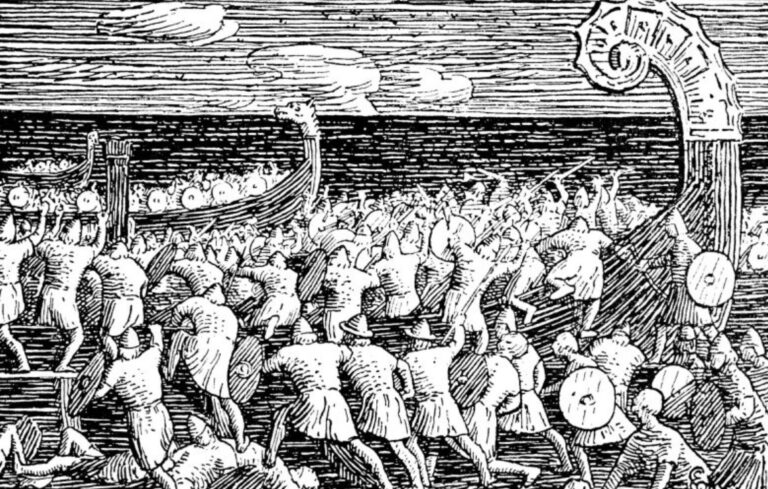
Týr recorded the kvæði ‘Ormurin langi’ on ‘How Far to Asgaard’ (2002). It tells of King Olaf Tryggvason’s ship, the Long Serpent, in the sea battle at Svolder around the year 1000, a story found in Snorri’s Heimskringla. The ballad itself is not medieval. It was composed by Jens Christian Djurhuus (1773–1853), a farmer in Kollafjørður, and its oldest known written copy dates from 1819.
Reading the sleeve notes
None of this makes the music any less interesting. It does mean that “ancient” on a sleeve deserves a follow-up question or two. Which manuscript is the text from, and how old is that copy? Who supplied the meaning: the medieval poet, or a modern interpreter? The songs are new either way. The words have histories of their own, and those are worth knowing too.
Calogero Nicosia writes Mythic Harmonies, an evidence-based guide to Norse mythology, runes and their sources, including an index of Viking symbols sorted into the genuinely medieval and the modern: https://www.mythic-harmonies.com/runes-magic/viking-symbols-evidence-index/
Main website: https://www.mythic-harmonies.com/
Image credit: Earl Eirik’s men boarding the Long Serpent, by Halfdan Egedius, illustration for Heimskringla (1899). Public domain.
