
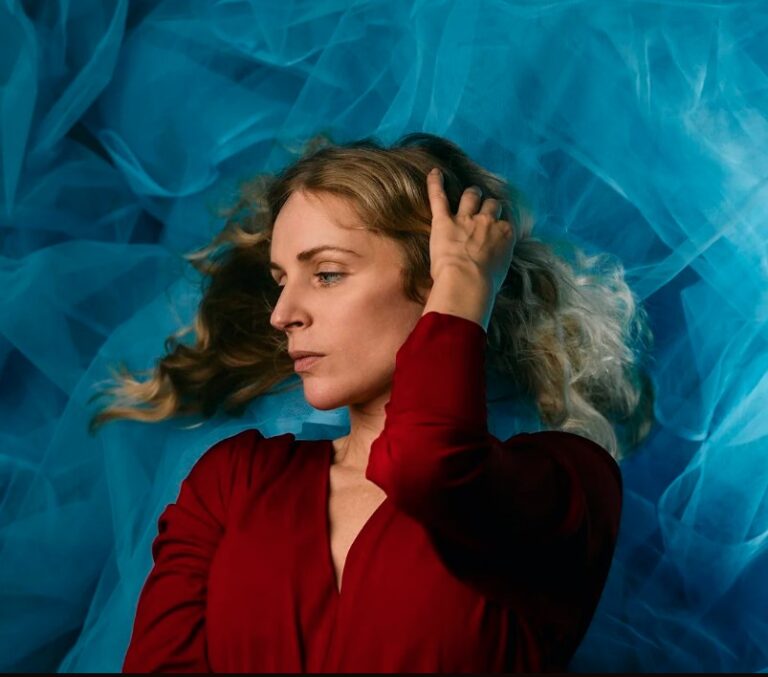
Agnes Obel, delicate powerhouse of a musician, sits at her end of our video call, hair still a little wet, thrown around, a voice huskier than normal, the effects of a sickness post-New Zealand leg of her tour still hugging her. Quiet, attentive, listening to questions – not always easy ones – considering her responses, wrestling with her present condition, even when there are minimal answers it does tell us about Obel. If she cannot locate an answer, or the reason for just that, it also fills in gaps about the way she thinks. In fact, it is highly admirable that she doesn’t just toss out an answer to satisfy her readers, rather remaining true to her essence.
Just as Obel’s music feels intimate, extremely sensitive to nature and the world around, her answers reflect the woman at the heart of that – honest, humble, intelligent, focused. The following interview took place as autumn took over beyond our separate European walls:
Nordic Music Central (Dominic J Stevenson): How does it feel now your fifth album, ‘The Meaning of Flowers’, has seen the light of day and what kind of response has it been met with?
Agnes Obel: Well, I’m very happy with the album. That’s my main thing. I think I can’t come with a sort of overall comprehensive of how it’s been. I finished it end of April, started preparing for a tour and then went on tour in June and then in Europe and then finished the tour in Europe first of September and then I started doing all this promo and then we flew to Australia and then I just came back from New Zealand a few days ago and then I got sick. So, I don’t have any like feeling, like overall feeling for how this is also, I can’t say that.
NMC: What does the new record mean to you?
AO: I think it’s a little bit – I don’t know how to say that.
NMC: Does it capture well where you are at this stage of your life? Does it reflect who you are better than your previous works? How will you look back on it? How do you feel about it now? What significance does it have for you?
AO: It’s very hard for me to sort of just answer this simply because it’s a big subject, this album and took me many years to make. And I don’t… what it means to me is sort of obviously it means like a whole. the whole period where I worked on it. So, it’s a long period.
NMC: When did you start working on it?
AO: In 2020.
NMC: Okay, so when you released your last album, you started straight away with this one then?
AO: Yes, because the last album we had a tour planned and everything got cancelled because of the (Covid-19) pandemic. And then I started working on, so I didn’t know it was going to be an album in the beginning, but I started working on it, I think in the summer of early summer of 2020, with ‘The Meaning of Flowers’ (the title track). Yeah.
NMC: It’s an amazing place to start the record. And I must say that your first single, your lead single, is it ‘Laymelli’, with your deeper voice on there. It’s a fascinating song that I like a lot. So, can I ask, what would you like other people to feel when they listen to this new record? Or do you just put it out there?
AO: You are asking all the questions I cannot answer because I never think about this. It’s not working for my brain. I am often asked stuff like that. And it’s something I on purpose avoid to think about. I did an interview and the interviewer or journalist said this album was more commercial compared to other albums. You know, it’s like I… it’s not something I, it’s not what drives the thing for me. And actually, I don’t even really like to think about it because it makes me, yeah, it’s not working for my curiosity.
NMC: Do you mind if I ask – how has your approach to making music changed since becoming a mother?
AO: Yes, it is also hard to answer because in a sense it hasn’t changed. I’m still, this is how I work. What has changed is what interests me or maybe it has changed. Maybe I’ve become less critical, and I take it less seriously, I would say. Before I had this sense that it was sort of life and death when I made music and I don’t have that anymore at all. For example, now we released this new album and before I would be very worried from the time up to a release. And this time I was like, let’s see, I am fine either/or. And so, I think somehow I feel a little bit more free also in my relationship to my music.
NMC: Well, your priorities shift, don’t they?
AO: Yeah, but it’s… Of course, that, but it’s also just like the awareness of, I don’t know, it’s like, I think it’s a way, it’s sort of, it just cannot be that important somehow. Also, in a way, it’s just before my life was just music. Only all we did; my partner and I were working. And I feel like, so it has changed, but the way I work is pretty much the same. And the way I sort of build up the songs.
NMC: Can I ask what kind of a child were you yourself? And what were you interested in when you were younger?
AO: Yes, I guess I was like, I don’t know what kind of child. I was interested in music already when I was a kid, but I was also interested in dancing and sports. I played a lot of badminton as a kid. I also went skiing a lot. I was very sporty and into music. I was kind of a kid who always went straight from school to something.
NMC: And how have you changed as an adult and how have you stayed the same?
AO: Yeah, good question. I don’t know. I think my music is my connection with this sort of… you know, this very straight axis to the now that children have. And sort of being sort of in flow with the moment and being in that without thinking about some things in the future, in the past. That I think I have when I make music, but I also really use a lot of energy in protecting it, like not thinking about how it’s received and stuff like that. It’s a good story to do it. But yeah, I think I try to, but it’s not always too easy, but it’s definitely sort of the goal for me to be more in contact with that.
NMC: So, my next question is, your music seems like such an intimate world that you create, it seems so personal. How does it feel when you go and perform to share that with people?
AO: So, in the beginning, it feels strange just when you play it. But then you get used to it. Because I play a lot of shows. But in the beginning, it’s actually what is the strangest for me is when we do rehearsals. Then the musicians have to play the songs and sing it and stuff like that.
NMC: Just as a kind of extension from that, what do you prefer, building and making a new album in the studio or going out with the songs and playing them live?
AO: No, studio, absolutely. Yeah, no, no, I’m not in this work for playing live. That is something I’ve grown to appreciate lately. But it’s not something, you know, it’s not something I need at all.
NMC: So, if you were able to just not do it, you would prefer to not do it then?
AO: No.
NMC: Or less.
AO: Yeah. It’s changing. So that was a good thing about the pandemic for me was that I had time to rethink about how I was living. And I realised that I didn’t maybe enjoy playing live at all. And I was thinking, why don’t I like it? And everybody, all my friends who are musicians, they were all missing playing live and performing. And then I found out I really just need to have it very, you know, very alive when we play live so we click and like to have it as open as possible and creative as possible. So lately we have changed it quite a lot. So, I also play now with very, very wonderful musicians that make it very much more interesting for me to play. So, stuff like that. But I really used a lot of energy to try to make the live thing interesting to me. And I think it is now, but it’s probably not because of me, it’s probably because of the people I play with. They’re incredible. The band I play with now.
NMC: It’s very nice to hear you speaking like that about them.
AO: You should check them out. For example, the drummer Julian Satorius is like one of the most amazing drummers you can find. And just the way he is playing, just to look at him when we play concerts. Inspiring. He’s like in contact with something very cool, he’s a very amazing musician.
NMC: Okay, are some of them the same musicians you’ve worked with for a long time or are they more recent?
AO: It’s kind of new, yeah, and I wrote him to play on the album because he was the only drummer I could sort of imagine could play this sort of strange eclectic drums that I had built up, and I didn’t know him. I just sent him an e-mail. He’s from Switzerland, so he drove up to Berlin with his drums and we recorded. And it was incredible. It was great. And then after that, I asked him if he wanted to play live. So, I played with him this year and last year. So, it’s new. And then I played with Hinako Omori, also only this year and last year, and she’s also amazing musician, and then Marie-Claire Schlameus, she’s a German musician, cellist. I played with her a little bit before, but it’s also just now and she’s also amazing. And they all three make their own super cool music and albums.
NMC: Oh, cool. I’ll have to check that out.
AO: Yeah, I can really recommend their solo projects.
We then discuss several topics not relevant to Agnes’ career and life, but we land on my hailing from Nottingham in the East Midlands of England.
AO: Yeah, I played in Nottingham.
NMC: It seems like lots of people know Nottingham, you know, my football team. And then it’s a city that seems to draw people there.
AO: It’s a cool city. I like it so much. I played that. I was in Nottingham when my first album came out. I remember I wrote not far from the Sherwood Forest.
NMC: People often visit there; I’ve got long hair and people call me Robin Hood sometimes. And yeah, Nottingham is great, I haven’t been back for a long time.
NMC: So, what does nature bring to your musical world?
AO: Yes. It’s a very hard question. It’s a broad question to answer because obviously nature is there, but I can’t like say I like to use imagery from nature directly.
NMC: Okay, so genres can be quite suffocating, but what kind of space do you feel you reside in as an artist?
AO: I think I try to make songs. I write songs. It’s the way I sort of structure my work because if I don’t have like this song format, then it becomes maybe too, there’s too many possibilities in a way. So, for me, I like to keep at least the idea about having some verse or chorus, and some other kind of structures like that. And I think that’s based in the songwriter tradition, you know?
NMC: Can you tell me three albums that you return to again and again?
AO: Yes. I listen to, yeah, what would I say? I would say Joni Mitchell, ‘Blue’. And then I would say, oh my God, my brain is not working right now. Let me just look at my playlist because I have no memories anymore. Yeah, so the Talk Talk album ‘Spirit of Eden’. And I would say, a pianist (the name is somehow lost here). She made one album, which is amazing, and I return to it again and again. I wish I could play piano like that, basically. Okay. She has her own timing and it’s incredible.
NMC: And who are some figures that you most admire? Or even just one person in any realm in life, or history.
AO: There’s so many. I guess I was so lucky to open for David Byrne. And I saw him also just as a human being, how curious he was and alive and in love with life. And I think it’s a very, very nice way of approaching your art, but also just approaching other human beings and life. Yeah, I really admire this way of being alive in the world. With this childlike curiosity.
NMC: And do you feel like an artist can ever discover what they creatively seek?
AO: Yes, of course. Yes, I think they can.
NMC: And which song of yours do you feel best encapsulates you?
AO: Oh, this I can’t answer. I don’t look at it like that.
NMC: And is there a track by somebody else that you feel encapsulates you well?
AO: No, no, I try not to. I try not to let myself be encapsulated or whatever. I think it’s not healthy to define yourself. We are all like all the time in flux and changing all the time. And I don’t think it’s a cool project for yourself, for your own self growth to be so focused on finding out who you are because it’s probably changing.
NMC: And last question then, what are your hopes for the future?
AO: Hopes for the future? I hope all these horrible things on the horizon won’t materialise. Climate change and AI catastrophe. And I hope for music and for art, I hope there will come a thing where we are more focused on the human expression and the idiosyncratic, unique expression of music and not something perfect that sounds like nothing. You know what I mean? So, I think it’s already happening, but it’s always about to happen. And I’m very curious to see how music will respond to this sort of AI and this perfectionist push. Yeah, I’m very hopeful for that because I think there are people will start or are already longing for the imperfect idiosyncratic musical output and expression. So, I think there’s gonna come a lot of really cool stuff soon. But as a parent too, of course, I’m really worried about the state of the world.
NMC: Yeah, it’s much worse when you’re a parent. We can put good energy out there, but we can’t stop these crazy dictators doing what they’re going to do.
We have to bring things to a close there. We have a moment for a goodbye, and she vanishes into thin air, like her music often seems to in a wisp of smoke, as if it were just a beautiful dream. Our final word…
NMC: Well, I hope you get better soon, Agnes, and thank you very much for your time today.
AO: Thank you. Nice to meet you too.
