


We’re a little late with this one but better late than never.
Jay Matharu is English but has lived for some time in Uppsala, Sweden’s fourth largest city, to the north of Stockholm.
And he isn’t the only one. We’ve reported on several British artists that are based in the University city; there appears to be a mini Diaspora of them.
As I’ve mentioned previously I tend to shy away from some jazz forms because I feel I’m insufficiently educated about what sounds like the loosest, least structured form of music when it is anything but, enhanced as it is by improvisation (over ‘Head/Changes and Head again’ to use the jargon.)
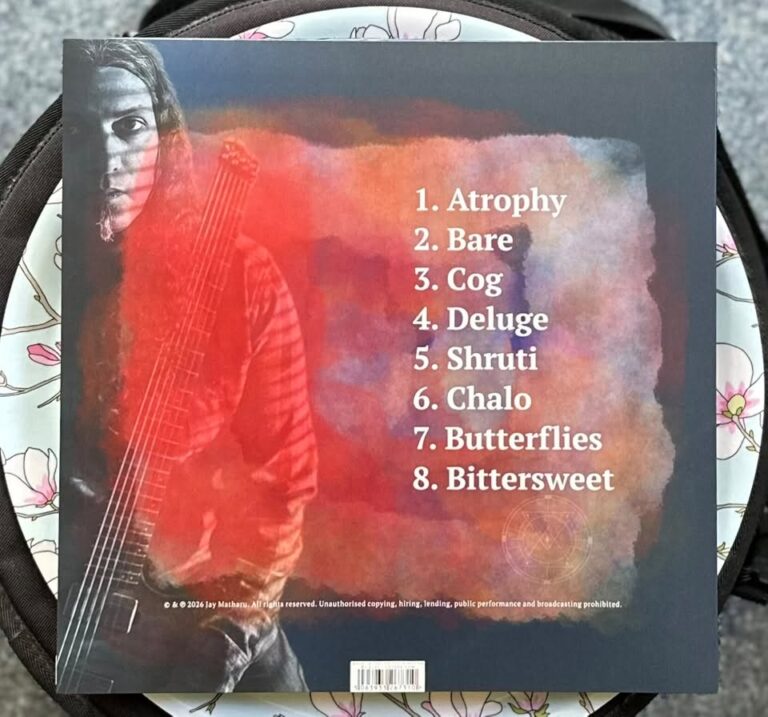
Where jazz fusion is concerned though it’s another matter and on this track, ‘Atrophy’, the opening one from his eight-track album ‘Disillusion’ which was released in July 2026,and as he does throughout the album, he manages to combine jazz, progressive rock, and Indian classical influences, although I wasn’t to know that at first.
I commented earlier on structure and improvisation. The album is built out of the latter and of ‘feel’, with compositions holding onto their initial spontaneity.
‘Atrophy’ means wasting and I was informed there is a degree of tension in the piece throughout the jazz sections, which “resolve themselves in the rising chromatic patter of the outro” or however it was that the British TV comedy sketch ‘Jazz Club’ described one of their artists in the 1990s.
Joking apart there actually is a genuine ‘resolution’ in that outro but not before something fascinating happens. At 2:22 and 2:50 respectively there are two remarkable insertions that are pure 1970’s Prog Rock. The first might be Steve Hackett of Genesis tapping out a melody to another fantastical story creation off ‘Foxtrot’ or ‘Nursery Cryme’ and the second a brief snatch of ELP on ‘Tarkus’.
Together they got me searching the Press Release for any mention of Prog and lo and behold there it is: Prog has played a big role in his background while Spotify also tells me that he has worked on high level collaborations across diverse musical landscapes including the Swedish metal scene and that even today he continues to perform with the progressive symphonic metal band, Hexed.
A man of many talents and what I do truly appreciate is how he managed to combine them so effectively across a three and a half minute track.
It puts into perspective what ‘jazz fusion’ can mean, never mind ‘cross-genre’.
And here’s another thing. Just before writing this I was watching/listening to one of those oddball feeds that turn up on the Nordic Music Central Facebook page. It was a female musician with a short lesson on how not to treat a muso if you are in a backing band – he or she is the guy paying for studio time by the hour after all.
For example, the session is 45 minutes in, the drummer hasn’t turned up yet and no one knows where he is. Meanwhile the keyboardist played the wrong chord on the outro to the first song and part way through the second one the bassist is still arguing with him about it.
No such problems for Jay Matharu.
The project was recorded remotely, with saxophone, bass and drums tracked separately before being brought together into a cohesive ensemble sound – an approach that suits the album’s spacious, reflective character while still leaving plenty of room for dynamic interplay.
Q.E.D.
(Continues after the Spotify link)
Find him on:
Website: https://jaymatharu.com/
Facebook: https://www.facebook.com/Jaymatharuguitarist
Bandcamp: https://bandcamp.com/jaymse
